The New Jim Crow: Intro || #SJBookClub

So! The current pick for the Social Justice Book Club (#SJBookClub) is The New Jim Crow by Michelle Alexander. Our club is a little more structured this time, with multiple posts planned for the month. For more info about the club and our schedule for this book, visit our host Kerry McHugh’s blog Entomology of a Bookworm.


1. Where do you plan on discussing this book the most? Feel free to share links to your blog, social media channels, snap handles, etc.
I’m planning to be here on my blog and tweeting (@alisa) with our group hashtag #SJBookClub. I use Tweetdeck (it’s free), and I have a column set up there just for the club so I can see what everyone is talking about.


There are three posts planned for this book (intro, midway, and wrap-up) and I want to post for all three, even if I am a little behind. I’m still waiting on a library hold.

2. Why did you decide to join in on the reading and/or discussion of this book?
I’ve been with the club since the start, and it’s pretty hard to get rid of me if I don’t want to be gotten rid of. I used to serve in a social justice position at a nonprofit before I moved overseas, and I expect that talking about and participating in social justice activism will always be a part of my life.

Both of our prior reads were also related to injustice in the US industrial prison complex (my thoughts on Just Mercy and The Long Shadow of Small Ghosts), and I’m actually glad that we are getting a thorough look at a singular topic.

3. In the very first line of the introduction to the book, Michelle Alexander writes, "This book is not for everyone." What do you make of that as an entree into The New Jim Crow?
I read a quarter of this book over a year ago and put it on pause. But from what I remember, Alexander uses strong, direct sentences and hard data to shake the reader into alertness about what is going on in America: institutionalized racism.

I had a conversation with a friend of mine recently about how as white women who are actively, daily trying to educate ourselves about being aware of the language we use and the comments or even body gestures we make to break the cycle of racism in our lives, we still make mistakes, we still get things wrong, we still don’t even realize that something is racist/offensive/condescending, and we feel guilty about that.

That guilt and a resulting desire to overcompensate is called white fragility and it’s a real thing.

I think that’s what the author means when she says that her book is not for everyone. Feelings are going to get hurt and some people aren’t mature enough to handle those hurt feelings so they react with their hackles raised, silence, hostility, guilt, fear, argumentation.

4. What, if anything, are you most looking forward to about this book?
I want to know about specific legislation that went into place after the civil rights acts as a way to compensate or get back to preserving legalized racism. For example, today we think of gerrymandering as a way that Republicans legally ‘steal’ votes from Democrats. But before that, gerrymandering was a way to steal votes from African Americans.


I’m looking forward to chatting more and I'm crossing my fingers that my hold comes in soon enough for me to join in for the mid-month check-in! It's not too late to join us!
Review || Simon vs. the Homo Sapiens Agenda

After millions of people told me to read Simon vs. the Homo Sapiens Agenda, I have finally read it and can now join the masses in insisting that you should read it, too!

The wait list at my library for an ebook of Simon is many months too long. But while vacationing and checking out the new-to-me Vista Grande library in my hometown of Casa Grande, Arizona, I spied Simon there, clean and new and untouched, waiting for me to read it. Which I did in less than 24 hours. I fangirled to the poor circulation desk librarian about how these days all I read are ebooks and I really miss reading on paper and how the stack of books I grabbed have an endless wait list and are OMG popular. He seemed a bit surprised and not in on the world of YA fandom.

When I was younger in Casa Grande, I volunteered at the library, and my ‘boss’ was the children’s and youth librarian (who I now realize was a liberal gal who took a job in a small, conservative agricultural community). I really am grateful for the things she taught me and the experiences I had because of her. I think that if I got my master’s, it would be in library science with the goal of doing youth programming. Anyways, it’s symbolic to me that I was reading this book while being back in my home town, with my younger sister reading over my shoulder.

Simon is a teenage boy who is busy dealing with the drama of typical high school days and navigating just how exactly he should come out.

Not only is the plot well designed, but because author Becky Albertalli is a practicing child psychologist, the characters feel incredibly realistic and authentic. It didn’t read at all like an adult trying to use teenage jargon—it came across as a teenager using teenisms (which may make the book have a shorter shelf-life than normal, but it’s perfect for the moment).

Again, the author is a genius. She deliberately links emotions and physical actions to show that what someone is doing on the outside is a result of something going on on the inside, and those inside things are totally, completely normal. For example, at one point in the story, Simon is upset and having a conversation at the same time. After a moment, he realizes that he is yelling and he feels embarrassed about having a hard time controlling his voice level. It’s these types of details that separate believable YA from adults-writing-to-kids YA.

Simon’s fears and concerns are just so relatable. He talks about wanting to keep even small things as a secret from his family (really small: he started drinking coffee), because they turn everything into a big deal. I still do that! And in a completely non-preachy scene near the end of the book, Simon’s mom explains that as a parent, every new development is an amazing and exciting change, no matter how small. Like new moms posting with way too much TMI on Facebook, moms of teenagers are just as excited.

I wish I had read this book when I was younger, for the sake of realizing how normal my family and feelings really are. While I was reading it, I imagined myself as a youth librarian, recommending this book to someone and it changing their world so that they would remember it years later, even if they never talked to anyone else about it.

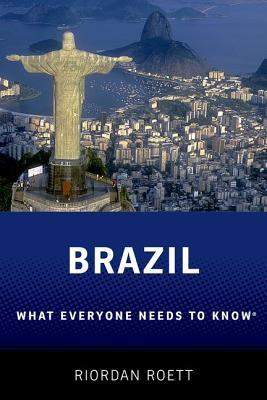
Brazil: What Everyone Needs to Know

Brazil: What Everyone Needs to Know is a Q&A field guide for navigating the history of the world’s seventh-largest economy.

In a series of leading questions and answers that are grouped chronologically according to the periods of government that the country has passed through, author Riordan Roett (The New Brazil; China’s Expansion into the Western Hemisphere: Implications for Latin America and the United States) explores Brazil’s history with an economist’s lens. Succinct explanations of Brazil’s rapid transitions of power are given, citing shifting revenue sources as the motivating factor for change. The second half of the book picks up questions of racism, poverty, education, crime, gender inequality, foreign policy decisions, and global competitiveness.

Roett is quick to address leadership faults in the stagnated Brazilian government (“The political class appears stuck in time.”) and points to examples of countries leading the way (Mexico, Chile, and China) while a scrambling Brazil struggles keep up. The result is like a disappointed teacher scolding a foolish student: “To fail to address the agenda in the next government...could have serious social and political tensions with unforeseen consequences.”

In this no-nonsense and practical read, Roett weaves an effective primer for readers looking to dig a bit deeper about the problems facing South America’s largest country and host of the 2016 Olympic Games.


Thank you to Oxford University Press and NetGalley for providing me with an eARC of this title!

The Long Shadow of Small Ghosts || #SJBC

X Bienal de Nicaragua by Abraham Cruzvillegas (source) - an exhibition exploring the relationship
between individuals and their environment
The second pick for the Social Justice Book Club (#SJBookClub) was again a contemplation about capital punishment and who deserves it. Unlike our first read, Just Mercy, which focused on the completely innocent or those who clearly don’t deserve the death penalty, The Long Shadow of Small Ghosts hovered on a man who, with his wife’s help, stabbed his three toddlers to death in the border town of Brownsville, Texas.

John Allen Rubio, the father of the children, has issues: an abusive childhood home, low IQ, extensive drug use, poverty, and mental illness (including what appears to be schizophrenia). He says he killed his children because they were possessed, which he had confirmed when he performed a folk-healing ceremony.

Author Laura Tillman spends much of the book expatiate about how to decide if someone deserves to be killed for their crime, if we should judge psychotic-John-at-the-time-of-the-murders or a competent John who had emerged from his psychotic episode. Although this type of mulling and re-visiting thoughts trying to understand your own position on the death penalty might interest some readers, I have to say that at many points in the book it was very clear that Tillman lacks a guiding compass that Brian Stevenson (author of Just Mercy) uses to make everyday decisions about his life, work, and spirituality.

The persistent wondering about questions of life, death, mercy, and justice without seeking input from any of the world’s recognized philosophers, deities, or spiritual guides bothered me because it came across as a very American idea of naively going on a one-woman journey to find profound answers that one will be able to uncover within oneself. As in, the conclusions that Tillman reaches through talking to neighbors, visiting the haunted apartment where the murders happened, writing about her feelings, being skeptically curious about Mexican witchcraft/folk-healing, etc, will guide her to a place where she will decide for herself, based on her emotions, if she thinks someone deserves to die: “I, and you reading this, we are compelled to decide if we want to kill John. I need to look him in the face.”

I believe that only God has the right to decide if, when, and how someone dies. The whole argument of “Was John crazy or not at the time of the murders, and thus deserving of capital punishment or not?” becomes immediately irrelevant if you don’t believe in capital punishment. John could be the most cruel and calculating sociopath ever, he could have done far worse than stabbing his kids, and I still would say that he gets to die when God decides.

X Bienal de Nicaragua by Abraham Cruzvillegas (source)
It’s hard to know how far Tillman’s journey led her on the subject of capital punishment, because she doesn’t clearly state her starting position in the beginning. But near the end of the book, in a particularly eloquent passage comparing the destruction of the historical building where the murders took place and the reason the US uses capital punishment, she writes:

“To kill another person exists on another plane from the act of dismantling bricks and wood beams. The parallel is found in the satisfaction promised by destruction: to lend the weight of tangibility to the ephemeral. You can take a mallet and bust into the wall of a building. You can load poison into a syringe and inject it into the body of a human being. You can see them both reduced to absence. Then, we are left with nonexistence, a blank space. A piece of earth can host another structure, and though it will be different than what came before, it can serve a new purpose. But when a life is gone, it is not replaced.”

The various times that Tillman brings up the role of architecture and place in shaping history and communities is where she really shines. What relationship did the claustrophobic, windowless apartment have in provoking Rubio’s madness? And what effect does the knowledge of the existence of a still bloodstained room have on the neighbors? Like much of the book, these questions have less tangible answers, but they remain fascinating to me.

Lessons in Belonging from a Church-Going Commitment Phobe

Provocar Urbanos, Vinicius S.A.

I’m not a commitment phobe, and you would think that after being in churches my whole life, there is no place that I would feel like I belong or fit-in more. I feel solidly about my core beliefs that are common across all major Christian denominations. I’ve visited more styles of Christian gatherings than the average seminary student, thanks to my parents experimenting with different theologies, lots of travel, and my birthright from the ‘Show-Me State’ (Missouri).

What attracted me to Lessons in Belonging from a Church-Going Commitment Phobe was a creeping feeling that after living only a quarter of my life I’m already getting burned out on church. I was looking for some strong words that would make me wince but not sting (a complete stranger is sometimes best for this), and point out that yes, church is worth the effort.

Erin S. Lane did not disappoint. She and I have a lot in common: grumpy introversion, haters of small talk, good at justifying excuses to ourselves, curmudgeonly feminists… and I underlined most of the book, not because 100% of it was SO GOOD IT WILL CHANGE YOUR LIFE, but because I recognized myself in her. Like this sentence that is not only my physical reality about my presence in church, but my mental one as well: ‘An increasing number of folks my age are choosing to live on the edge of belonging; we may not be fully in or fully out, but we are not “nones.”’ (‘Nones’ is the current buzzword to describe millennials that believe a higher power exists but aren’t interested in participating in organized religion.)

Part memoir, part advice, Lane writes about how her fear of commitment led her to hopping around the country and wrestling with herself about trying to become part of yet another church full of stale platitudes, alienating patriarchal language, and awkward meet-and-mingle sessions. At the same time, she was working for a Quaker retreat organization, so many of her lessons stem from attitudes of honest acknowledgement and acceptance of reality that are common in Quaker teachings.

Belonging, she decided, is not about conforming with what other people do, say, or believe. You can have different opinions, interests, backgrounds, education, and languages. ‘Belonging didn’t chiefly depend on whether a community accepted me but whether I was able to offer myself to them.’

Becoming disillusioned is part of the process of belonging--disillusioned in the sense of tearing down the illusions that we construct in order to ‘fit in’. It’s being honest about what your resources and talents are, and offering those. It’s about acknowledging what other people are good at and accepting what they are offering. It’s about revealing weakness in order to accept others’ gifts. It’s shifting the responsibility of belonging from other people to yourself. It’s showing up, being present, and serving others.


P.S. If you are tired of other Christians preaching at you, gag a little when you hear the word ‘relevant’, are annoyed by petty theological discussions, and couldn’t care less if the entire Christian celebrity industry with all of its books got taken up to the heavens in a chariot of fire (which would hopefully burn said books) tomorrow, then this book will probably be fine for you to read because it has none of those things.


I received an e-ARC of this book in exchange for an honest review. Words and opinions are my own.