Showing posts with label fantasy. Show all posts

Things You Should Know Before Reading Outlander

I was in the mood to read a fantasy series, but I had some requirements to meet:

1. The series should be four books or more.
I was itching for such a long series--maybe because trilogies are so common, and one-off’s are my usual, so I wanted something that stretched on and gave me returns for my investment into that fantasy world.

2. The author should be a woman.
I’ve been making an effort to avoid reading books by men, so yay womanpower!

3. The main character should be a woman.
Yay womanpower!

4. A romantic relationship should be an important part of the story.
Raise your hand if you think Tolkien should have written a lot more about elves making noble sacrifices for love instead of so many pages of scenery descriptions. *raises hand*

So, I asked the internet, and the internet gave me the Outlander series! Yay Scotland! It does indeed meet all the requirements: fantasy, female author, female MC, lots of books, and romance.

HOWEVER

The fantasy is minimal. Apart from one (1) short time-travel episode, one (1) loch ness monster sighting, and one (1) scene in which the MC Claire ‘heals’ someone from PTSD using psychological methods that are so ill-advised that I will call its success a fantasy element, there is NO FANTASY. This is historical fiction, which I also love, but no dragons, no magic, no dice.

There are a lot of sexy times. Do you ever have the problem where you want to read a novel with romance, but not necessarily a romance novel? And then it’s really hard to comb through google results because it’s hard to explain the difference to a computer? (side note: the word for ‘novel’ in Portuguese is ‘romance’, so just add more layers to that confusion.) I am not one of those people who is going to diss anyone for reading books with covers depicting buxom ladies making out with Fabio. But just be aware, unlike I was, that a sex scene happens about every 50 pages, and the book is 900 pages.

There is a violent male-male rape. And partner abuse. So, warning.

Despite being written by a woman and the mc being a woman, this story is anti-feminist. Let me tell you how all but one of the adventure scenes happen.
Sexy Jamie: Claire, don’t do THE THING. 
Claire: YOU’RE JUST SAYING THAT BECAUSE MISOGYNY!! 
Claire: *does THE THING* 
Claire: *needs to be rescued* 
Sexy Jamie: *rescues Claire* 
Sexy Jamie: See, I told you! 
Claire: You were right!!!

ON THE OTHER HAND

There are really good pictures of how tough life was on the Scottish highlands in the 1740s. A lot of work, dirt, cold, disease, animals, and skirmishes.

Diana Gabaldon is from Arizona (*waves excitedly*) but she has clearly done her research: she frequently describes medicinal plants found in the highlands (she has a PhD in ecology) and uses many words of Scottish origin that I had never heard before.

Carlisle Castle, the site of many a Jacobite battle and the filming location
for an important part of the Outlander TV series.
The Jacobite risings and politics is explained through the narrative, so I am bound to remember it. When I went to Scotland a couple years ago, I had never heard of the Jacobites and had a hard time understanding some of the museum displays… it’s a wee bit complicated to keep everything straight.

The characters are really fun. They make jokes, they are passionate, they are quick to forgive, and they are courageous. I kept cheering for them the whole time.

So, have you read any fantasy series that meets all of my requirements? Give me the goods, people!! Stop being bad dragons and hoarding the treasures all for yourself!!

Another Turtle: I woke up in a world without Terry Pratchett


A long time ago, a mad mathematician, with a very questionable attraction towards his niece, wrote a poem called Jabberwocky and inserted it in his book Through the Looking Glass. It’s a poem that describes… Something. Something magical. Amorphous. Crooked and mysterious. It doesn’t make any sense. It was one of the first and most expressive exponent of Nonsense, this form of art that at times consists of knocking coconut shells together and pretending you’re riding a horse through English fields searching for holy grails, and that influences the spinning of the world since someone realized that 'humor' and 'sense' are concepts that can go through a very harsh divorce. It was there, expressed in another form of art, one much more spread out and much less interesting. Literature, in its most original and profound sense, is the work of tying letters one to another in a coherent way and make something out of it. Literature, in its most practical sense, is the construction of books, narrated stories, through words. Literature, in its most metrosexual sense, is what people call 'real books', as if there existed in the world something like 'false arte'.

Terry Pratchett said once that people accused him of making literature.

As I write these words, I have been waking up in a world without Sir Terry Pratchett for thirty-four days. He was a British fantasy author who wrote more than forty books, and he even beat J.K. Rowling as the 'most read author in the United Kingdom', right in the middle of the Potterian frisson.

Thirty-four days in which the world is rounder, in the bad way. Without that disc shaped planet that Pratchett created, balanced on the backs of four elephants, standing on the shell of a galactic sea turtle. Thirty-four days without that fantastical form of writing that makes him guilty of all literary charges.

Pratchett’s writing was truly very elaborate. Few times has the world seen someone that made words, its meanings, its lyricism and its transcendence dance in favor of the story being told with apparent effortlessness. He did it with grace, with hardness, with rhythm and with fervor. Even so, many people decided to ignore Pratchett because the bulk of his work belonged to 'smaller' 'genres': comedy and fantasy.


Pratchett used fantasy and comedy the same way a painter uses the color blue. Sometimes in the sky, as background. Sometimes in a bird, as the subject of the painting. Sometimes as one of these hip and modern painters whose paintings are entirely blue, and you don’t understand what exactly what is he doing, but the painter never meant for it to be 'understood'. His comedy and fantasy were not only the 'back setting', as in many other works. They took the central stage to become theme, transport, model, explosion. Pratchett managed to blend in satire and elaborate 'high fantasy' concepts with the purest nonsense comedy in a phenomenal way. His attention to detail was enviable. For example, in a disc shaped world, no one followed directions such as 'north, south, west, east', but rather 'center, border, anti-clockwise and clockwise'.

Comedy is, for all of us, a relief and a weapon. And Pratchett pointed that weapon at everyone. Classic literary archetypes, the insanity of religious extremism, the power systems that rule the world. And the son of a bitch had the audacity of doing so with a surprising level of humanity. His characters indeed are witches, barbarians, tourists, insurance salesmen and conman wizards, but they are all so human (except for the Librarian. He is an orangutan). Their weaknesses and their dreams are as epic as the ones inside all of us. His most beloved character, Death, is Discworld’s angel of death (only his job, not his personality), and many times all that he wants is just a farm and a family, and not all that ruckus of souls, work accidents and assassination. He spoke always in uppercase letters, and was the character that best understood the adventures of human being. Another of Pratchett’s recurring themes was popular culture. Mythology, cinema, music, politics, everything went to the Discworld and to his other works as jokes, but such accurate jokes that, once the hemorrhage had stopped, you’d reach a new level of understanding.

His main strength was the magic he performed with words, subverting expectations and meanings in each paragraph. Deconstructing prejudices and creating life. The actions and situations on his disc shaped world almost never followed the common sense of our globe shaped world, but different from the Jabberwocky, they reached somewhere. Not exactly a classic moral lesson, but a new unfolding of what you thought you knew a lot about.

There was another author, also departed far too early, that had much in common with Pratchett, but had much more prestige outside Britain. Douglas Adams even had a big budget feature film made based on his The Hitchhiker’s Guide to the Galaxy, which is referenced in 11 out of 10 conversations of these nerds of today, who completely forgot about the time when being a nerd was a crime. Pratchett did to fantasy what Adams did to science fiction. But Pratchett, who managed to insert just enough heart and actual philosophy, rather than idle sarcasm and one-liners, was a superior writer. (Yes, my friends, I have touched a bastion of literary paradigm. Next time I’ll trash talk Tolkien).


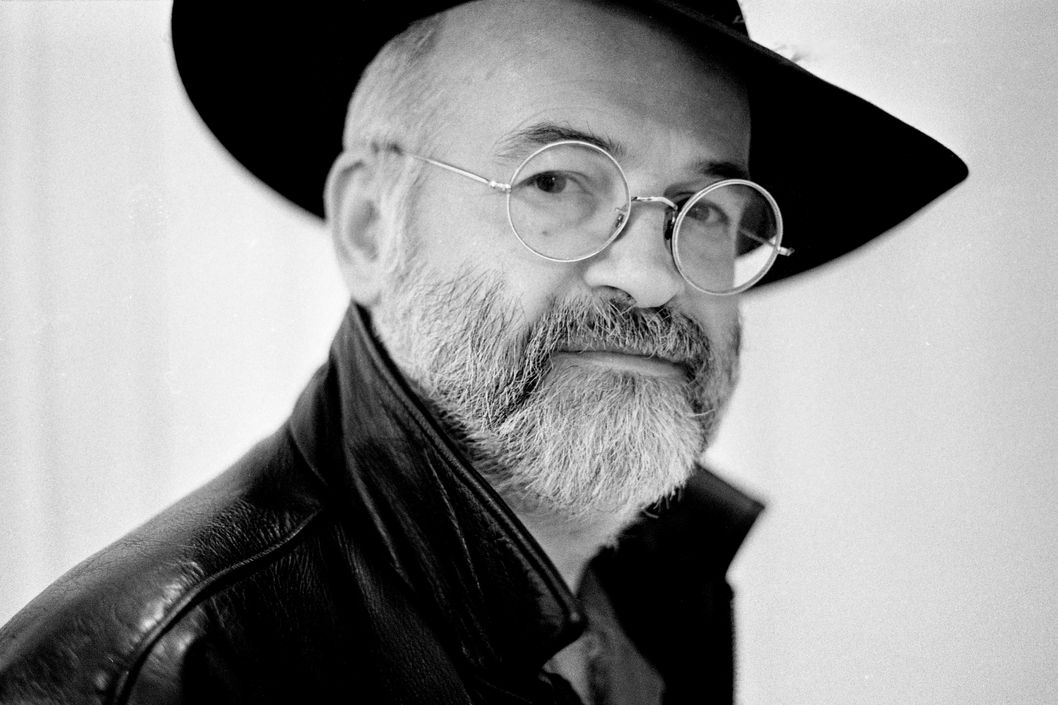
His most famous friend, Neil Gaiman, (whom he wrote Good Omens with) said that people should not be confused: Pratchett may appear to be a kindhearted old man, with his wordplay, his black fedora hat and his appearance of 'Sigmund Freud with more recreational and less heavy drugs', but in fact Terry Pratchett was furious. Furious with the world, with the institutions. Furious with his own mind, deteriorating quickly because of the advanced state of Alzheimer’s he was in. Furious with the government that didn’t allow him to euthanize.

Pratchett’s fury may have been righteous, but I disagree with it being his cause. Pratchett created awe, love, heroism and nobility from pariahs and evil spirits. His endings were not only 'happy', but they were the rest after a very crazy adventure (and they were never what you expected them to be). Pratchett may have had his fury as his locomotive, but used it to reach a place of beauty.
That was Terry Pratchett for me. The man that, in my opinion, filled with humbleness and 45% trustworthiness, was the best writer alive.

Until March 12, 2015, when his disease, defined by him as an 'embuggerance', took him to meet his greatest character, tall, boney, always smiling and always speaking in FULL CAPS. And together they went to search for another turtle, somewhere far from here.

The wizard Rincewind. Granny Wheaterwax. Captain Samuel Vimes. The Librarian. The useless Mort. Death. Cohen, the barbarian. Lord Vetinari. Moist Von Lipwig. The Luggage. Twoflower, the tourist. The Wee Free Men. Vampire. Small gods. Guards. Dragons. The great turtle A’Tuin.

We are all orphans now.

Go in peace, Sir Terry.


Thank you so much to wonderful Silas Chosen for writing this homage to Terry Pratchett. If you are curious and overwhelmed about reading the Discworld books, don't fret, it isn't a series that needs to be read in order (a tell-tale sign of what is to come). But, if you insist, here's a Discworld reading chart to help guide you.

image sources: 1, 2

3 Reasons to Read 'A Darker Shade of Magic'


Since I read tons of book blogs specifically about YA fiction, it’s pretty normal for me to see more than five book reviews of the same newly released book in one week. Because I like seeing how different people write reviews, I go ahead and read them all. What I end up finding is that one review tips the scales and convinces me to add that book to my TBR, not because it is such a beautifully-written review, or even because it was a positive review. It’s usually because of one sentence that mentions something that I’m interested in.

I know that recently tons of reviews of A Darker Shade of Magic have been being posted. It’s a fun, well-paced book about magical young man who can travel between different versions of London and starts on a quest to “throw the ring into the fires of Mount Doom” (so to speak). But, maybe you haven’t added it to your TBR list yet. Here are three reasons that might tip the scales:

There is no romance.
Sometimes I’m in the mood for a good, clean, fun romance (I’m headed straight to you, Rainbow Rowell). But most of the time I would much rather skip the does-he-like-me drama, unconvincing love at first sight (let’s be real and call it hormones or lust), or the brave yet undecided girl-caught-in-a-love-triangle. I think it’s too shallow and narrow-minded to assume that all teens, or all readers have relationship issues and can/want to relate to characters that do. I didn’t and I don’t. I want to read books about friendships with excellent interpersonal character development. A Darker Shade of Magic portrays good light-hearted friendship, cooperation, and playful banter between the main female and male characters.

It’s definitely fantasy, but you don’t have to be a super-nerd to enjoy it.
The Chronicles of Narnia has a wide audience appeal because the fantastical elements don’t require a lot of effort from the reader to grasp, the pacing remains steady, and the invented world doesn’t differ much in appearance from our own. Compare TCON with Lord of the Rings--which fantasy style asks more of the reader? ADSOM uses fantasy and magic in ways very similar to The Chronicles of Narnia and Harry Potter.

It has a great female character.
She’s spunky, pushy, determined, tries to be self-reliant, and keeps a positive attitude. She has big goals that she’s working towards (though I wouldn’t say her goals and line of work are exactly something you should aspire to follow). She’s clever and quick-witted. And she has some obvious flaws. Sometimes she appears more like a cartoon character than a real-live person we might encounter in the world, but the key thing here is that she’s not simply a vessel (skip to ‘Exhibit A’).

Did I convince you yet? If you’ve read ADSOM already, can you think of more reasons to convince potential readers?

Totally in love with Maddy Kettle: The Adventure of the Thimblewitch

Beautiful, whimsical, enchanting, playful. I tore through Maddy Kettle: The Adventure of the Thimblewitch and needed to see more; there simply isn’t enough of author-illustrator Eric Orchard’s work. Unfortunately, a scrounge around the web revealed little more than some old interviews and that he graduated from the Nova Scotia College of Art and Design (does he earns points just for being Canadian?). Online, he is frequently referred to as “an up-and-coming illustrator.” I think it’s safe to say that he has arrived.

(source)

Maddy is an Arizona girl (holla!) who needs to turn her parents, currently an adorable pair of kangaroo rats, back into humans. Her adventures lead her to fantastical creatures, magical machinery, and delightful surprises. Some scenes are reminiscent of Dorothy visiting Oz.


Others, of Jules Verne and H.G. Wells—a steampunk aesthetic quietly seeps into many frames.


Besides the talent and skill with the individual illustrations, the momentum between frames is what takes this book to another level. Look at this page: a chain reaction from the first frame causes the banjo string to snap in the second, a zoom out in the third frame flavours the entire page with humour and drama, and now we know why Maddy is looking down in frames four and five.


Yes, this is a children’s graphic novel. But it is more than that. It is a work of art. I want it for my (future) children. But I also want it for me.

(note: I received this as an ARC ebook for free, but that didn’t affect my opinions stated here)

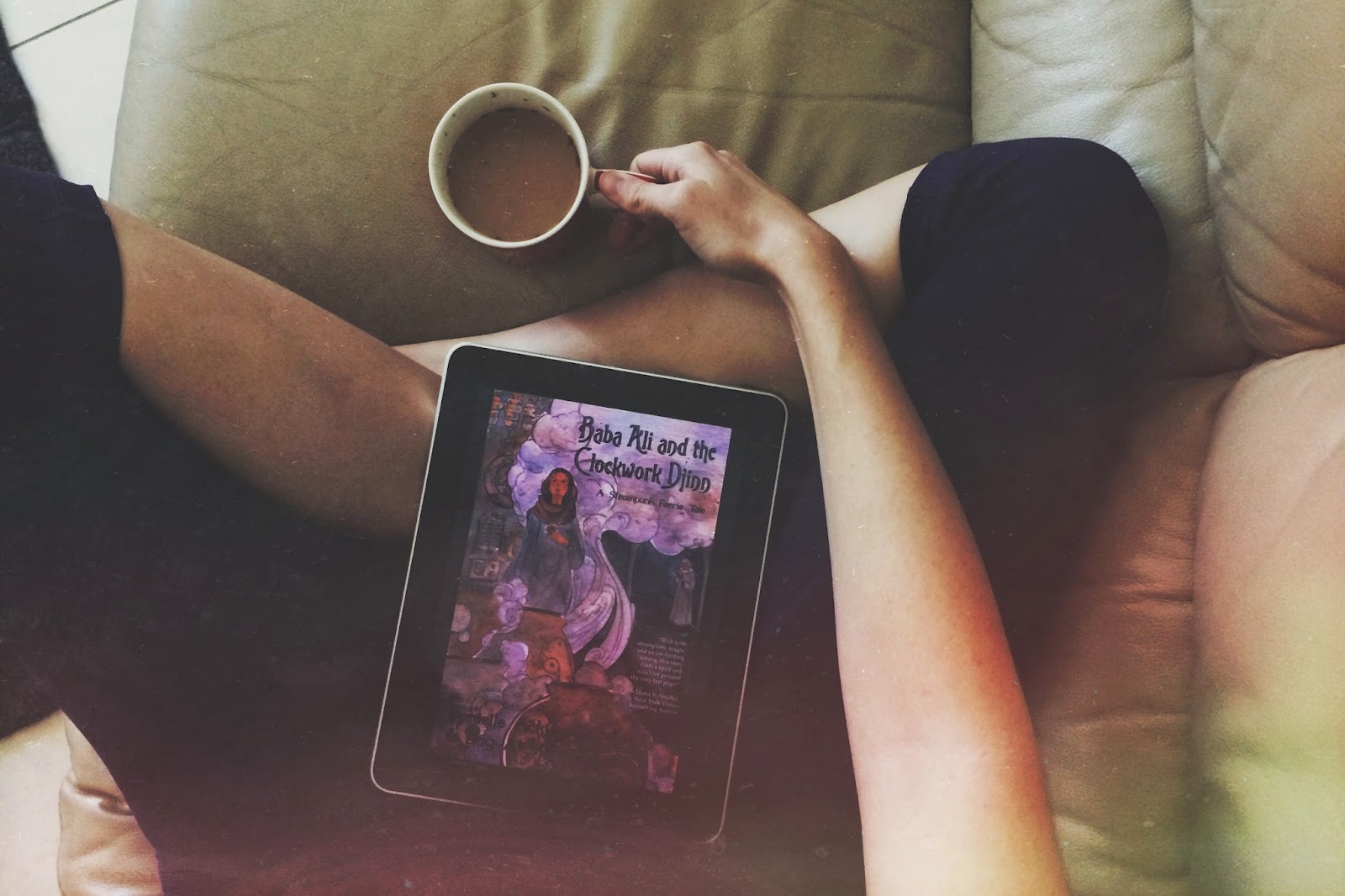
An Arabian Nights Remix: Baba Ali and the Clockwork Djinn

If you were to guess that this book is a retooled tale of Ali Baba and the Forty Thieves, you would be correct. Like any good fairy tale, it is not incredibly original. We seek out fairy tales because of their familiarity. Consider why most western fairy tales have events in sets of three (e.g. Goldilocks and the Three Bears, the Twelve Dancing Princesses and the three night challenge…) – to let us get comfortable but not too comfortable, to add suspense as we search for the change in the pattern, to give us a skeleton for retelling and embellishing the tale for the next generation.

Baba Ali and the Clockwork Djinn

The authors, Danielle Ackley-McPhail and Day Al-Mohamed, rely heavily on the structure of a couple of the more famous Arabian folk tales: there are forty thieves, a vast treasure that once belonged to the caliphate, an enchanted cavern that reveals itself to the words “open sesame”, and a djinni (anglicised: genie) that is trapped in a bottle and a ring, among other elements that readers familiar with the traditional tales will recognize. But they go beyond the familiar to weave a tapestry infused with strands of Arabic, Persian, and Egyptian culture and vocabulary, create scenes that transport the readers to the early twentieth century Arabia (if it had magic and steampunk additions), and teach us about the nature of the Islamic faith through the patient piety of Baba Ali.

Ali is a 18-year-old Arab boy, doing an engineering apprenticeship in England. The book begins by following him as he seeks to complete a simple errand, but shows his exhaustion as he is discriminated against and antagonized by the homogenous, unwelcoming streets of London.

Self-Published Spotlight: Alora by Tamie Dearen

I have a prejudice. I will watch cell phone videos of a person in a dirty bedroom playing a guitar with interest. I supported Radiohead when they released In Rainbows sans record label. I love the forefathers of contemporary art because they thumbed their noses at the institutionalized rules. Recently, Youtube serial dramas have filled the void in my life created when I stopped watching TV seven years ago.

But books? No. There are just too many reckless users of the English language out there and I am not going to bother wasting my time unless it has the official stamp of approval. And a professional editing job.

After reading an article about how the book industry is the last snobbish holdout against the internet-fueled creative revolution, I decided to confront my prejudice. How could I say I disapproved of self-published books if I had never read one?