Showing posts with label memoir. Show all posts

Lessons in Belonging from a Church-Going Commitment Phobe

Provocar Urbanos, Vinicius S.A.

I’m not a commitment phobe, and you would think that after being in churches my whole life, there is no place that I would feel like I belong or fit-in more. I feel solidly about my core beliefs that are common across all major Christian denominations. I’ve visited more styles of Christian gatherings than the average seminary student, thanks to my parents experimenting with different theologies, lots of travel, and my birthright from the ‘Show-Me State’ (Missouri).
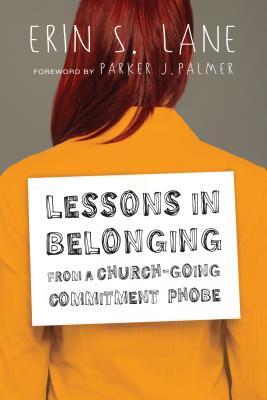
What attracted me to Lessons in Belonging from a Church-Going Commitment Phobe was a creeping feeling that after living only a quarter of my life I’m already getting burned out on church. I was looking for some strong words that would make me wince but not sting (a complete stranger is sometimes best for this), and point out that yes, church is worth the effort.

Erin S. Lane did not disappoint. She and I have a lot in common: grumpy introversion, haters of small talk, good at justifying excuses to ourselves, curmudgeonly feminists… and I underlined most of the book, not because 100% of it was SO GOOD IT WILL CHANGE YOUR LIFE, but because I recognized myself in her. Like this sentence that is not only my physical reality about my presence in church, but my mental one as well: ‘An increasing number of folks my age are choosing to live on the edge of belonging; we may not be fully in or fully out, but we are not “nones.”’ (‘Nones’ is the current buzzword to describe millennials that believe a higher power exists but aren’t interested in participating in organized religion.)

Part memoir, part advice, Lane writes about how her fear of commitment led her to hopping around the country and wrestling with herself about trying to become part of yet another church full of stale platitudes, alienating patriarchal language, and awkward meet-and-mingle sessions. At the same time, she was working for a Quaker retreat organization, so many of her lessons stem from attitudes of honest acknowledgement and acceptance of reality that are common in Quaker teachings.

Belonging, she decided, is not about conforming with what other people do, say, or believe. You can have different opinions, interests, backgrounds, education, and languages. ‘Belonging didn’t chiefly depend on whether a community accepted me but whether I was able to offer myself to them.’

Becoming disillusioned is part of the process of belonging--disillusioned in the sense of tearing down the illusions that we construct in order to ‘fit in’. It’s being honest about what your resources and talents are, and offering those. It’s about acknowledging what other people are good at and accepting what they are offering. It’s about revealing weakness in order to accept others’ gifts. It’s shifting the responsibility of belonging from other people to yourself. It’s showing up, being present, and serving others.


P.S. If you are tired of other Christians preaching at you, gag a little when you hear the word ‘relevant’, are annoyed by petty theological discussions, and couldn’t care less if the entire Christian celebrity industry with all of its books got taken up to the heavens in a chariot of fire (which would hopefully burn said books) tomorrow, then this book will probably be fine for you to read because it has none of those things.


I received an e-ARC of this book in exchange for an honest review. Words and opinions are my own.

'Welcome to My Country' puts us in touch with mental health struggles

Recently I have been on a pop-psychology binge, fueled by my plunge into several amazing podcasts. This led me to download or request all of the remotely interesting e-books that my library has on the subject... and my three-day holiday weekend just got completely full.

I started with Welcome to My Country by Lauren Slater, a thin memoir about the author’s experiences of working with six memorable mental health patients. The language is poetic and introspective—fans of Ann Voskamp will revel in this—as Slater intertwines memories of her own mental health struggles, the collective human spirit, and primordial physical processes with those of the patient to help the reader understand that really, the problems of “the other” are all of our problems.

Published in 1996, it’s now a teensy bit dated in the fast moving world of what is and is not politically correct to say. The first chapter is particularly hard to swallow with phrases like, ‘I can tell, from his fatness and his sweat, [that he is] a patient.’ Uh, what? Perhaps Slater’s Harvard education trained her olfactory nerve to be sensitive in a way that us plebeians just aren’t able to understand.

Her writing did get significantly better each chapter, as she reflects on former patients with the following conditions:
  • a group of men with schizophrenia
  • Peter, with anxiety that manifests as abusive misogynism
  • Joseph, with schizophrenia and hypergraphia (compulsive writing)
  • Marie, with depression and bulimia
  • Oscar, with schizophrenia and catatonia (becoming physically ‘frozen’)
  • Linda, with borderline personality disorder (though that chapter is more about Slater confronting her own past)

The book stays very positive in light of the heaviness of the subject, yet it still manages to give proper gravity to very serious stories. It doesn’t give a false sense of hope or flippancy to the daily struggles of the millions of people struggling with some type of mental illness. I think the author showed that making progress towards healthy, sustainable independence takes a lot of work, a lot of patience, and a lot of time. She encourages us to be more patient with people in our own lives (or perhaps even with ourselves!) who are on that journey.

Perhaps the best thing that I walked away with was this quote about the author's own journey towards healing:
‘Ultimately, it was not the treatments or their theories that helped me get better, but the kindness lodged in a difficult world.’
I may not ever be able to get proper training in therapy or psychology, and I’m probably not a great person for that job anyways, but we laypeople have an important job to do. We are the listening ears, the helping hands, the kind mouths, and the faith-full hearts that can give reassurance and hope to people who are fighting to stay in the country of the whole.