Showing posts with label graphic novels. Show all posts

This Week in Reading: Week 3

Gosh, what a heavy week—Obama said goodbye to public office, Trump was inaugurated and Republicans started wreaking havoc, oh, immediately. And the women’s marches around the world were great, but, you know, we have a lot of work to do.

Which is why I’m really happy that I read the following three books this week!

Mafalda #2 by Quino
I’m continuing with this Argentinian comic strip series that had so much success across South America during the 1960s-70s. It’s addresses war, human rights, the environment, and feminism in a warm, lighthearted way. Read in Portuguese.
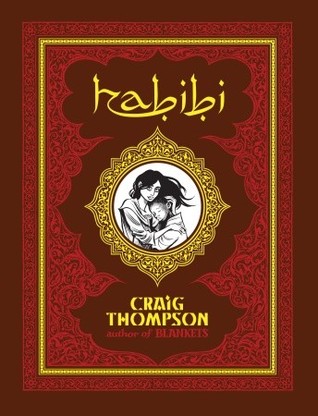
Habibi by Craig Thompson
I LOVED this book! Thompson studied Arabic calligraphy, the Koran, the Hadith, and Arab traditions, myths, and culture for nine years in order to create this book. The result is a huge tome stuffed with magnificent beauty that combines everything in a magical, heart-wrenching package. There were a lot of surprising, hard parts in the story, but what really stood out was the complexity of the combination the stories that come from physical calligraphy, with religious stories, and A Thousand and One Nights. Read in Portuguese.
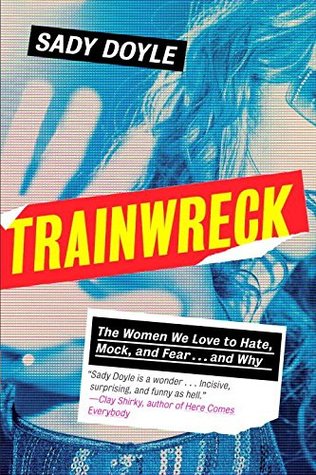
Trainwreck by Sady Doyle
So ideal that I finished this book on a sliver of contemporary feminism the same week as the Women’s March on Washington (and around the world)! A longer review is coming, but until then…
Doyle shows, using conversational blog-type language and mountains of primary source material (complete with citations in the back), that fabricating a trainwreck narrative out of women in the public eye is nothing new, and has existed for centuries. It comes from an impossible-to-achieve (examples in book!) standard and internalized patriarchy. We enable a fictional narrative to dominate our minds, bodies, and culture—the lie that there are "good women" and "bad women" and that all of us are either one or the other, when in fact we are all humans who make good decisions and bad decisions, who do holy things and sinful things... even the privileged, air-brushed celebrities.

3 Graphic Novel Mini-Reviews

Saturday is Free Comic Book Day! (Pss… Check here to see who nearby is participating.) Yeah yeah I know the difference between graphic novels and comic books, BUT in honor of illustrated story telling, here are some graphic novels I read recently!

Low, Vol 1: The Delirium of Hope by Rick Remender
In the future, the sun is on the verge of death and its solar rays are out of control. Humans live in underwater colonies to be protected from the sun, but the air supply is going sour and one ridiculously optimistic woman believes she has a way to save humanity… and her family. Full-color, richly illustrative, of course I love the way that undersea animals have evolved into beautiful scary creatures.
For fans of: metaphysics (the plot revolves around if positive thinking determines reality), dystopias, light sci-fi

Wayward, Vol 1: String Theory by Jim Zub, Steven Cummings, John Rauch
A teenage girl who grew up in Ireland moves in with her Japanese mom in Tokyo. She discovers she has supernatural powers to see things that other can’t. The infusion of Japanese mythology, full-color beautiful art, realistic Tokyo scenes, and interesting characters was fantastic.
For fans of: Miyazaki’s Spirited Away, contemporary stories based in Japan but not manga per se.

Twisted Dark, Volume 1 by Neil Gibson
A collection of dark short stories which feature recurring characters (if you can spot them!). The art styles vary and the plots are all totally different. The writing is pretty straightforward, but it’s interesting. I was most interested in the story about human slavery in the United Arab Emirates, because I used to live there. It was extremely accurate of what really happens, and the illustrations were so realistic that I could recognize specific parts of the city.
For fans of: text-reliant graphic novels, Alan Moore


The Book of Memory Gaps: A review of an illustrative experiment

Let’s start with the facts.

Cecilia Ruiz is the author and illustrator of The Book of Memory Gaps. She has an MFA from the SVA in NYC (the School of Visual Arts is the crème de la crème of 2D art education). She has illustrated for magazines like Accent, La Peste, and Life & Style. She’s also done the art for a couple books. As far as I can tell, The Book of Memory Gaps is the first book that she’s illustrated and written.

If you check out her portfolio on Cargo Collective, you can see her other work. I would like to draw your attention to the illustrations under the category: Personal Project. ‘Welcome Misfortune’ and ‘Box of Extraordinary Deaths’. Both are an illustrated series, pay attention to the latter. The format of ‘Box of Extraordinary Deaths’ is a quiet illustration accompanied by a pithy text which adds a small narrative and more importantly, a context.


Isadora Duncan is the most successful illustration of the set. It anticipates the disaster with a humorous and innocent voice, as if the dancer is skipping out the door to meet her friends, and pulls the scarf with her as an afterthought.

I mention this set of illustrations because The Book of Memory Gaps follows the exact same pattern. There are 14 vignettes that give a brief synopsis about each character accompanied by a “locket” sized cameo illustration of the character and a larger illustration of the character in his or her current context. The characters are tied together by the uniqueness of their memories and the small details that sets the collective story in a somber town that is reminiscent of a former USSR country (the Republic of Zubrowka, perhaps).

What is important to note is that each character is completely separate and isolated. Not only from the other characters, from any other character, but also from reality. The result is a haunting, quiet, and depressing look at flat characters who are stuck on repeat. You know how creepy it is to hear a record play the same two seconds of recording over and over again because somewhere along the way it got stuck? It’s like a book about that.

Compared to her other works, the ones in The Book of Memory Gaps are much more stagnant, less funny, and bleaker. I suppose this is intentional, considering the subject matter and setting. I picked two of my favorites to show you.

The Book of Memory Gaps by Cecilia Ruiz

The Book of Memory Gaps by Cecilia Ruiz

As you can see, her style leans more towards magazine editorial rather than a stand-alone book that relies heavily on illustration for three-fourths of its content. It really surprised me when I reached the end of the book in less than seven minutes (really). Like, that’s it?

So where does this book fit? As a senior thesis project, in a bookshelf of illustration books for inspiration to artists, as an extended visual essay in an eclectic magazine that specializes in such things. It’s an interesting experiment, and I’m happy for this artist’s career advancement, but does it deliver the purposed $16.95 worth of content? Debatable.


note: I received an advanced e-copy for review purposes but that did not affect my honest opinion of the book.

Ciudad: A fast review of a fast read

The basic premise: a Brazilian drug lord’s daughter gets held for ransom, and a bounty hunter is hired to bring her back alive.

(Read without fear… no spoilers be here)

Ciudad, by Ande Parks, Joe Russo, and Anthony Russo, reads like an action flick, which is probably why it was picked up for a silver screen adaptation by Sierra Pictures. It is fast paced, violent, gritty, and features all the twisted corruption that we love about South American politics. In spite of its predictability, and the characters being more like caricatures than real people, I found myself liking it for the same reason people like action movies. It’s racy and entertaining and not from my world.

Totally in love with Maddy Kettle: The Adventure of the Thimblewitch

Beautiful, whimsical, enchanting, playful. I tore through Maddy Kettle: The Adventure of the Thimblewitch and needed to see more; there simply isn’t enough of author-illustrator Eric Orchard’s work. Unfortunately, a scrounge around the web revealed little more than some old interviews and that he graduated from the Nova Scotia College of Art and Design (does he earns points just for being Canadian?). Online, he is frequently referred to as “an up-and-coming illustrator.” I think it’s safe to say that he has arrived.

(source)

Maddy is an Arizona girl (holla!) who needs to turn her parents, currently an adorable pair of kangaroo rats, back into humans. Her adventures lead her to fantastical creatures, magical machinery, and delightful surprises. Some scenes are reminiscent of Dorothy visiting Oz.


Others, of Jules Verne and H.G. Wells—a steampunk aesthetic quietly seeps into many frames.


Besides the talent and skill with the individual illustrations, the momentum between frames is what takes this book to another level. Look at this page: a chain reaction from the first frame causes the banjo string to snap in the second, a zoom out in the third frame flavours the entire page with humour and drama, and now we know why Maddy is looking down in frames four and five.


Yes, this is a children’s graphic novel. But it is more than that. It is a work of art. I want it for my (future) children. But I also want it for me.

(note: I received this as an ARC ebook for free, but that didn’t affect my opinions stated here)

Sisters: the small stuff may annoy you, but they do have benefits

Here’s the gist: Little Miss Sunshine style road trip complete with the rickety VW bus, parents on the verge of a divorce, and family members that are too wrapped up in their own worlds to see the problems of the others. You can guess how it resolves.